
You can GO HERE to see a Glossary of terms.
Here are someTIPS that have been sent to me...THANKS!
There are many ways to mic a drum kit, but we'll look at some ways to do it with just a couple of mics
or as many as you have drums.
A note first though... Alot of factors will enter into play when micing an acoustic drum kit (or anytime
you use more than one mic to record a source for that matter) The biggest is the room your going to
record them in, this will have a major effect on the sound you get on tape. Room reflections
(sound bouncing off walls ect.), mic placement, furniture & music gear in the room all can play havoc
on the sound.
Since I don't have the room here to write a book on acoustics, I suggest one of the publications on my
links page or ask someone at your local music store for some help finding a book to help you with this.
TUNE'EM - TAPE'EM - OIL'EM
First thing is, try to make sure he/she has at least fairly new heads, this pretty important in getting
a good sound... Dead Heads = Dead Sound! Next, take some time to tune'em, if they don't sound good
now they won't sound good on tape!
Also, Duct tape can do wonders for all kinds of things... You can use it to tame down overly loud
cymbals, or cymbals that ring out too long, just put a small strip near the edge of the cymbal.
Same thing goes for toms & snare drums... Try not to rely totally on tape to stop toms from
ringing, try tuning'em first to see if you can get rid of most it that way before you start putting
tape on them.
Get out the 3 in 1 oil & oil up those bass drum & hi - hat pedals, there's nothing worse than a
squeaky pedal. Especially after you laid down a good take!
You can record a drum kit with as little as 2 mics, it's harder to get a good overall tight sound this
I would suggest using two mics on stands 3 or 4 feet above the middle of the kit, in an "X - Y" (see fig 1)
You'll have to move them around to get a good balance, so be patient & take your time... Time is free so
MIC TECHNIQUES
way (especially since most of us don't have thousand dollar mics) but if 2 is all you have it can be done!
set up, placing the 2 mics facing down at a 45 degree angle pointing at each other with the ends of the
mics almost touching. 2 Shure SM-57s will work fine this way, or what ever mics you have, try 'em !!!
It would be better if they were the same brand & type though...
use all you want!!!
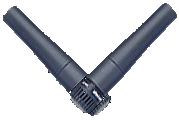
If you can put a mic on the snare & kick drum(s) as well you have a really good chance of getting a good
sound while still using only 4 or 5 mics.
Now we'll look at some ways I use to mic specific drums/cymbals... There are always
variations to these so experiment around to see what works for you.
CYMBALS & OVERHEADS
The "X - Y" method you saw above is a good way to mic cymbals, you can cover a pretty wide area
like this & still have some "stereo image" on the cymbals. You'll also have less "phase" problems
& "comb filtering" effect (sounds bouncing off of walls ect., being picked up by another mic a fraction
of a second later & canceling out part of the original sound)
If this just doesn't work & you want to separate the mics, try to triple the distance (i.e. if you have
the mics 3 feet above the kit, put them 9 feet apart, & ect.) or as close to that as you have room.
This should help with any phasing you might encounter.
If you have or get any condensor mics, use them on your cymbals. They have a better transient attack
than the dynamics, which means that the diaphram of a condensor is smaller in mass so it can move
faster. This means it can catch the initial "hit" faster & at a sharper peak, to me it seems to make
them "jump out" at you more. Though, as you might guess, the better the mic the better this will be.
SNARE DRUM
For the snare, a good ole' SM - 57, or a similar dynamic, works good, but try'em all! You never know...
I put the mic over the rim of the snare about 1 inch, pointing down at about a 45 degree angle & about
1 inch above the head.
A compressor on the snare can help alot too, especially if you set the attack time a little slower.
By doing this, you let the initial stick attack get by uneffected then the compressor kicks in & lowers
the overall level(reduces the gain that is). This will also even out the individual snare hits making
them more consistant & making your drummer sound like he/she is really hammering it!!!
Some settings I start with are...
COMPRESSION RATIO = around 4:1 (4 to 1)
ATTACK TIME = around 5 to 10ms (5 to 10 milliseconds)
REALESE TIME = around 200ms (200 milliseconds)
BASS DRUM
First thing on the kick drum is, if he/she doesn't have a decent sized hole (or none at all) in the front
head, take it off! You'll need the freedom to move the mic around to get a good sound...
The SM - 57 will work ok here too (pretty versatile) if you have a good large diaphram, high SPL
(sound pressure level) handling mic this would be the choice. But if your like I am right now,
it'll be the SM - 57.
I start by putting the mic in the kick drum about 4 inches from the head, & pointing right at where the
beater hits. Don't get too close, you can easilly overload the mic which leads to distortion. Try moving
the mic around to get a sound that works for you (1 inch either way can make a big differance).
Another thing I do is to put a piece of foam or extra piece of carpet under the mic stand to help keep
some of the vibrations from being picked up by the mic. this can cause a "muddy rumble" in your mix.
A compressor can help here too by evening out the individual hits & keeping you from overdriving your
board. You can try the slower attack time here too, to get a more pronounced "click" attack but watch
your release time! If it's too short, the compressor will try to "ride" the low frequecy wave forms.
But you don't want it so long that the following hit attacks get caught in the gain reduction from the
previous ones! (especially if he/she is really fast)
Some settings I start with are...
COMPRESSION RATIO = around 4:1 (4 to 1)
ATTACK TIME = around 5 to 10ms (5 to 10 milliseconds)
REALESE TIME = around 300 to 500ms (300 to 500 milliseconds)
TOMS
The SM - 57 works here as well (what a suprise!) But again, you can try any mic you have to see if it
works better.
I put the mic about 1 inch in over the rim pointing down at a 45 degree angle, & about 1 inch above
the head. I try to put it a little off to the side of the drum, so it's not pointing right at the snare.
You can also put one mic between 2 toms, just point it strait down between them & about 1 inch above
both rims. Not too far in though, or your drummer will knock the end off of your mic!!!
I also put the foam or carpet under the tom mic stands for the same reason as I do for the bass drum.
Try to aviod those mic holders that attach to the drum itself, you'll get major vibration from that!
You can compress (if you have that many!) the toms too but, if it's a choice between the snare & toms,
I would keep it on the snare. The same settings apply to the toms as they do the snare.
OTHER TIPS
SNARE
For an overly loud snare, you can use duct tape but it tends to stifle it in my opinion. A trick I,ve
used before is to take those annoying little "peanuts" you get when you order something thru the mail
(the little styrofoam ones) remove the top snare head & fill it about 3/4 full with them. Dont pack it
to the top, you don't want to kill the sound, just tame it down. This seems to work well.
For the metal "snares" on the bottom of the drum that rattle when you hit other drums or hit bass notes
or just about anything else! Get a piece of thin cloth (an old t-shirt is good) cut about a 3 inch wide
by 8 inch long piece, loosen the snares & slide it between the bottom head & the snares. Then tape or
staple the very ends together to keep it from coming back out. Make sure to attach just the very ends
together so it's loose & can still move. Don't get the cloth too thick or you'll lose the sound of your snare!
BASS DRUM
For the Bass drum head, use a Piece of foam about 2 inches thick & 10 or so inches wide & put it lightly
up against the head on the bottom of the drum. You can tape it or put a small weight on it to keep it from
moving around. You don't need a ton of padding in there, all that does is kill the sound when all you need
to do is stop the overtones & tighten up the sound.
Also, I usually don't promote the using of "Dead Ringers" but one of the best bass drum sounds I've gotten
is when the drummer had a dead ringer & a felt strip down one side (he also took some time to tune it)
Another thing, since most aggressive music has huge guitar sounds, you need to get a very pronounced
"click" attack on the kick to give it definition in the mix. Especially on fast double bass parts...
You can try a wooden or hard plastic beater, which will give you some more "slap" against the head...
Another trick for this, which sounds kind of silly but it works is, use a hard plastic beater & duct tape a
quarter or good sized washer to the head right where the beater hits. Make sure you only tape the edges
& leave the metal exposed... I tried this on some big & boomy 24 inch kicks, so boomy you could hardly
hear the attack at all. I taped a pretty good sized washer (a little bigger than a quarter) to the head
& "pow" instant attack, I was amazed myself that it worked so well.
TOMS
I have found that you can usually "tune out" the overtones on the toms, if you work at it a little you
should be able to get by with out any treatment. Try it before using tape on 'em, the'll sound alot
better & more lively. I know sometimes the bottom head of the floor tom can be a pain so I'll somtimes
take off the top head & lay a small piece of cloth on the bottom head inside the drum. This can help
calm it down with out effecting the sound.
CYMBALS
One thing I have found about cymbals is, if your drummer has "stage" crashes or other heavy crashes
you'll have a hard time getting a nice crisp sound. They sound great live when you really hammer them,
but when you record them they're very "dark" sounding (not in a good way). See if he/she can borrow a
couple of crashes for the recording, it'll sound a whole lot better.
A little bit of duct tape can do wonders for an overly loud cymbal... Also a crash or ride that rings out
way too long. Just put a small strip on the bottom near the edge.
GOOD LUCK!!!